Written by: Anand Sen; Reviewed by: Dr. Nuvpreet Singh
There’s an uncomfortable truth prevailing in this country. Many pet dogs are either partially vaccinated or have never been vaccinated at all. And cats? They are often not vaccinated at all because, as per Indian pet owners, “they don’t go outside.” This assumption is dangerous.
I recall a case we saw last year. A young couple brought their first pet, an indoor Persian cat, that never stepped outside and, in fact, never met another animal. Yet she experienced severe respiratory symptoms. Diagnosis? Feline viral infection (FVRCP group), which was most likely brought in via clothing or open windows. This is where understanding dog vaccinations vs cat vaccinations becomes critical.
India is considered the global hub of rabies as it records the highest number of human rabies deaths globally, with most cases being linked to dog bites. According to the WHO and the Journal of Global Health, more than 17 million dog bites are estimated annually, leading to an estimated 18000-20000 deaths every year.
Veterinarians at Conbun handle hundreds of vaccination queries every month from pet parents across Delhi, Mumbai, Bengaluru, and beyond. We have observed that this is one of the confusions among many pet parents:
“Do dogs and cats need the same vaccines?”
The answer is simple: NO. Absolutely not.
Cats and dogs face completely different disease risks, have different immune responses, and vaccination schedules. Vaccination schedules are especially important in India because of factors such as stray animal density, monsoon exposure, and a hot and humid climate. The extreme prevalence of rabies changes the game entirely. Yet, pet vaccination rates in India are considered low.
This guide will break down:
- Dog vaccination schedule India (2026)
- Cat vaccination schedule India (2026)
- Core vs non-core vaccines explained
- India-specific risks like Leptospirosis and rabies
- Cost comparison of pet vaccines in India
Because when it comes to vaccines, guessing is not an option.
Why Dog and Cat Vaccinations Are Not the Same
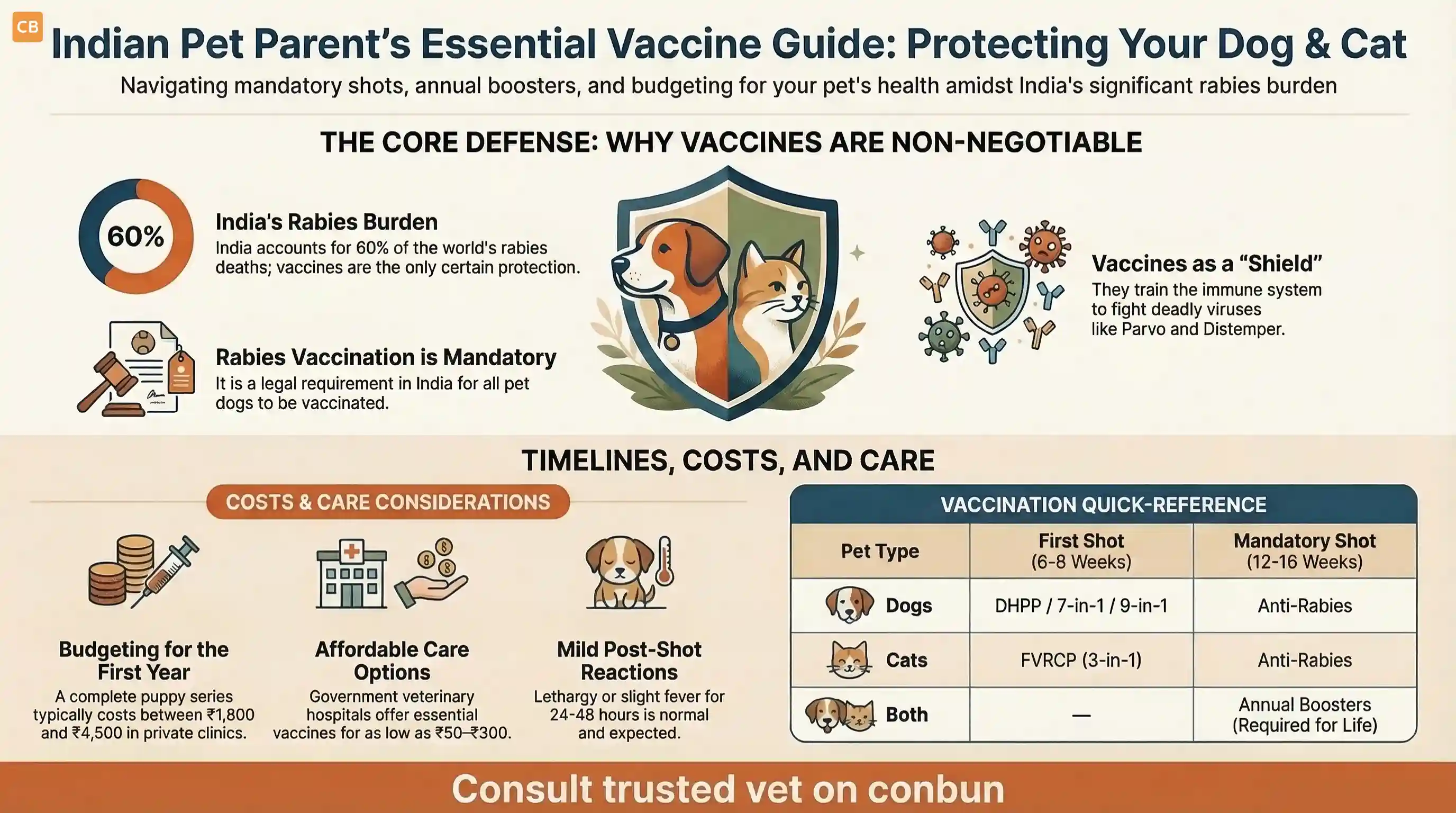
Dogs and cats fight different bacteria, viruses and environmental risks. Thus, their vaccines are entirely different. A dog vaccine cannot be given to a cat and vice versa.
Some diseases may sound similar to parvovirus, but the strains that affect dogs and cats are different.
What Are Core Vaccines?
Core vaccines are the vaccines that every pet must receive, regardless of their lifestyle and breed.
For dogs in India, core vaccines include:
- Distemper
- Parvovirus
- Adenovirus (Hepatitis)
- Parainfluenza
- Rabies
Core vaccines for cats in India
- Feline Panleukopenia
- Feline Calicivirus
- Feline Herpesvirus (Rhinotracheitis)
- Rabies
All these diseases are highly contagious and often deadly, which is why vaccination for these diseases is non-negotiable.
What Are Non-Core Vaccines?
Non-core vaccines for dogs and cats are the vaccines that depend on your pet’s lifestyle and location.
For dogs in India, non-core vaccines include:
- Leptospirosis (very important in monsoon cities)
- Kennel cough (Bordetella)
- Canine influenza
For cats:
- Feline Leukaemia Virus (FeLV)
- Bordetella (rare in India)
Non-core vaccines are risk-based decisions, best made with a veterinarian. It is advised that pet owners make decisions while their pets are in kittenhood or puppyhood. You can consult veterinarians online via pet health apps like Conbun to understand which vaccines are non-negotiable for your pets.
Dog Vaccination Schedule India 2026 (Vet-Approved)
Puppy vaccination schedule in India should ideally begin at 6 - 8 weeks of age. Between 14 and 16 weeks, rabies vaccines must be given, and it is also mandated by Indian law. After this stage, a booster must be given.
Here’s a simplified schedule:
| Age | Vaccine | Notes |
| 6–8 weeks | DHPPi | First core vaccine |
| 10–12 weeks | DHPPi + Leptospirosis | Leptospirosis important in India |
| 14–16 weeks | DHPPi + Rabies | Rabies mandatory |
| 12–16 months | Booster | Annual schedule begins |
| Every 1–3 years | Core boosters | Based on vet advice |
The dog vaccination schedule in India spans over a period of 3 years. Missing a crucial vaccine or a booster dose can put your pet at great health risk.
Indie Dog Vaccination - Does Breed Matter?
It is a common myth that Indie dogs (Indian Pariah dogs) don’t need vaccines as they are “naturally strong.”
Indie dogs do have better genetic resilience. It does not mean that they are immune to diseases like:
- Rabies
- Parvovirus
- Distemper
In fact, most Indie dogs are adopted from the streets and have an unknown vaccination history. This makes full vaccination even more important.
If you have adopted a street dog, you must follow the Indie dog vaccination schedule seriously, because you are not putting at risk the lives of other animals, but humans too, with Zoonotic diseases like Rabies.
Veterinarians on Conbun consultation app frequently come across cases where Indie dog owners from Delhi and Bengaluru have skipped Leptospirosis vaccines. This is a serious oversight given India's monsoon season.
A quick 10-minute consultation can give you crucial Conbun vet vaccination advice and help you decide whether your dog needs a specific vaccine, based on their lifestyle and other factors.
Cat Vaccination Schedule India 2026 (Vet-Approved)
While the cat vaccination schedule also begins at 8 weeks of age, the vaccines that should be given to kittens are completely different. Rabies vaccination should be given to cats due to their highly contagious nature.
| Age | Vaccine | Notes |
| 8 weeks | FVRCP | First dose |
| 12 weeks | FVRCP + Rabies | Important |
| 16 weeks | FVRCP booster | Complete series |
| 12–16 months | Booster | Annual schedule |
| Every 1–3 years | Core boosters | Based on vet |
Do Indoor Cats in India Need Vaccines?
Yes. This is one of the biggest myths that most veterinarians at Conbun encounter.
Even indoor cats can get exposed to deadly diseases through:
- Open windows
- Human clothing
- Visitors
- Balcony access
Viruses like feline herpesvirus and calicivirus are airborne and highly contagious. In addition, rabies risk is also very significant in India due to high stray density. Therefore, cats living even in urban apartments should be vaccinated.
Is rabies vaccine mandatory for cats?
Yes, the rabies vaccine is mandatory for cats in most parts of the country and is even strongly recommended for indoor cats.
What About FeLV and FIV in India?
The FeLV or Feline Leukaemia Virus (FeLV) vaccine is a safe and effective immunisation that protects cats against the fatal contagious virus. It is available in India and is generally recommended for outdoor or multi-cat households
The FIV or Feline Immunodeficiency Virus vaccine not commonly available and routinely used in India. It is considered a non-core vaccine in the Indian veterinary sector.
An online vet consultation with an experienced veterinarian can help you decide whether FeLV is necessary or not.
Dog vs Cat Vaccinations - Side-by-Side Comparison
While dogs and cats in India need rabies vaccines and annual boosters for the same, the diseases they face, other core and non-core vaccines and their combinations differ significantly.
| Factor | Dogs | Cats |
| Core vaccines | DHPPi (Distemper, Hepatitis, Parvovirus, Parainfluenza) | FVRCP (Rhinotracheitis, Calicivirus, Panleukopenia) |
| Rabies | Mandatory by Indian law | Mandated in most locations, it is strongly recommended |
| First vaccine age | 6–8 weeks | 8 weeks |
| Booster frequency | Annual (every 3 yrs for some dogs) | Annual (every 3 yrs for some cats) |
| Monsoon-specific non-core | Leptospirosis (HIGH priority) | Not typically required |
| Kennel/boarding risk | Bordetella/Kennel Cough | Feline Bordetella (rare, low India risk) |
| Cross-vaccination? | Never use cat vaccines on dogs | Never use dog vaccines on cats |
| Multi-pet household | Separate schedules needed | Separate schedules needed |
| Indie/stray rescue | Start fresh if history is unknown | Start fresh if history is unknown |
| Avg cost in India | ₹300–₹1,500 per dose Puppy vaccination package may cost ₹3000-5000 Anti-rabies vaccines are free in government animal hospitals | ₹300–₹700 per visit Kitten vaccination package may cost ₹2000-6000 |
India-Specific Vaccine Risks You Can’t Ignore
Due to different environmental conditions, weather, and stray animal density, most Western vaccination guides don’t account for Indian realities.
Monsoon & Leptospirosis
Leptospirosis is a serious bacterial infection that spreads through contaminated water, especially during flooding due to contaminated urine of infected rodents and livestock.
Cities at high risk:
- Mumbai
- Chennai
- Kolkata
- Kochi
Dogs walking in puddles and subways, especially during monsoons, are at a high risk.
Rabies in India
As per the WHO, rabies is considered endemic (constantly thriving disease) in India, and the country accounts for 36% of global rabies deaths. This shows the strong prevalence of this disease in India.
Rabies vaccination is:
- Legally required for dogs in many cities
- Also strongly recommended for cats
Distemper & Stray Exposure
Pet dogs in India often encounter stray dogs at parks/during walks, or in outdoor sessions. This increases the risk of distemper.
This disease particularly appears in winter and spring. The mortality rates of unvaccinated dogs reach up to 80%.
Stray dogs in India are considered the primary reservoir of this disease. The virus is highly contagious and causes severe respiratory, gastrointestinal, and neurological symptoms.
Feline Panleukopenia in Urban Cats
Feline Panleukopenia or “cat parvo” is a contagious viral disease prevalent in urban stray and unvaccinated cat populations.
This disease thrives especially in high-density areas and is rising in:
- Shelters
- Multi-cat households
Unvaccinated cats are highly vulnerable to Feline Panleukopenia.
What If Your Pet Was Bitten by a Stray?
Immediate steps:
- Wash wound with warm water and mild soap for 15 minutes
- Visit the vet immediately
- If the pet is vaccinated, a rabies booster is likely required
- Watch for signs like pus, swelling, pain, redness or fever
Do not wait.
If an immediate vet visit is not possible, consult a veterinarian online through the emergency vet consultation feature on Conbun and learn what you can do next.
How Much Do Pet Vaccines Cost in India? (2026 Estimates)
Typically, the cost of pet vaccines ranges between ₹800 to ₹3000, depending on species, city, clinic and vaccine type.
| Vaccine | Dog Cost | Cat Cost |
| DHPPi | ₹800–₹1,500 | NA |
| FVRCP | NA | ₹700–₹1,400 |
| Rabies | ₹300–₹600 | ₹300–₹600 |
| Leptospirosis (rates in cats) | ₹400–₹800 | |
| Annual visit total | ₹1,500–₹3,000 | ₹1,200–₹2,500 |
Key Cost Insights
- Costs may be high in metro cities like Mumbai, Delhi and Bengaluru
- Government hospitals run subsidised or free anti-rabies programmes at many locations
- Tier-2 cities are more affordable
How Conbun Helps You Save Money
Instead of blindly following breeder advice or random schedules from the Internet:
Consult a vet online on the Conbun app to determine exactly which vaccines your pet needs and save on non-essential ones. Avoid unnecessary repeat vaccines
A ₹199–₹299 consultation with a veterinarian on Conbun can save thousands on vaccines and unnecessary clinic visits.
Signs Your Pet’s Vaccines May Be Overdue or Incomplete
One of the most dangerous patterns that I see Indian pet parents practising is “no vaccination”. It is an incomplete or outdated vaccination.
It typically starts due to a lack of awareness.
A breeder says, “Don’t worry, all vaccinations are done.”
A rescue dog comes home with you, but with no paperwork.
A busy year passed, and the annual booster quietly slipped.
And now, your pet is walking around and playing with other dogs with partial protection in a high-risk environment like India.
Here’s a quick, vet-approved checklist to assess your situation:
Vaccine Status Checklist
- No vaccination card or proper records available
- Pet adopted from a stray/rescue background
- Last booster missed by 6+ months
- Recent illness delayed scheduled vaccines
- New puppy/kitten with no vaccine start
- Recently moved cities (different disease exposure)
- Multiple pets with mixed vaccination timelines
If even one of these is applicable, your pet’s vaccination status is not reliable, and their health may be compromised.
What NOT to Do
This is where even experienced and knowledgeable pet parents go wrong.
Avoid:
- Ordering vaccines online and attempting self-administration
- Relying on verbal claims by the breeder or pet shop
- Following generic Western schedules without the Indian context
Vaccines are temperature-sensitive. If they are not in freezing environments, they become ineffective and in worst cases even harmful.
What You SHOULD Do
Instead:
- Talk to a qualified veterinarian
- Review the vaccination history of your pet (even photos of old cards help)
- Restart or adjust the schedule if you think it is compromised
Conbun makes this process extremely simple.
You can:
- Upload vaccination records
- Get them reviewed by a verified vet
- Receive a personalised vaccination plan in minutes
Real Conbun Case: How a Delhi Pet Parent Avoided a Monsoon Risk
Just before the monsoon in 2025, a first-time Labrador owner named Meena from Dwarka, Delhi, reached out on Conbun.
Her breeder told her that all vaccines were done. But apparently showed no vaccination card.
This is when the confusion actually started.
During a 15-minute video consultation, a Conbun vet reviewed her dog’s history and asked a few simple questions:
- Is your dog vaccinated for Leptospirosis?
- Does he walk outdoors daily?
- Does your area have constant waterlogging during the monsoon?
The answers revealed a critical gap.
While her dog had received core vaccines like DHPPi and Rabies, he had never received the Leptospirosis vaccine, a major risk unvaccinated dogs face in Delhi’s monsoon conditions.
Leptospirosis is highly contagious and spreads through contaminated water. Just a simple walk in a flooded park exposes a dog to the risk.
Veterinarian on Conbun immediately
- Provided a written vaccine recommendation
- Shared nearby verified clinics
- Set a reminder for the next booster
- Within a week, Meena’s dog was protected.
A quick consultation with the vet prevented what could have been a serious and even life-threatening infection.
Her review later said it best:
“I didn’t even know Leptospirosis was a thing. Now I tell every dog parent I know.”
Conclusion: Don’t Guess Your Pet’s Vaccine Schedule
Dog and cat vaccinations are not interchangeable. They’re not optional and definitely not something you can figure out later.
Between rabies, monsoon disease like Leptospirosis and rising urban stray density, the vaccination schedule of your pet is the most important health decision you need to make.
Whether you have:
- Labrador puppy in Bengaluru
- A rescue Indie dog in Delhi
- A Persian cat in Mumbai
- Or a mixed multi-pet household
Every pet needs a specific, time-sensitive vaccination plan.
And here’s the good news:
You don’t need to stand in long clinic queues just to ask basic questions.
Book a Vaccine Consultation on Conbun instantly with a verified Vet
Get clarity in minutes:
- Personalized vaccine schedule
- India-specific recommendations
- Cost guidance
- Booster reminders
FAQs (People Also Asked)
1. Can I give my dog's vaccine to my cat to save money?
Answer. No. Dog and cat vaccines are formulated for entirely different species, viruses and immune systems. Cross-vaccination can be potentially dangerous.
2. Do indoor cats in India really need vaccines?
Answer. Yes. Even strictly indoor cats in India need vaccines. There are airborne viruses like Calcivirus, Feline Herpesvirus that enter through clothing and open windows.
3. What is the first vaccine a puppy needs in India?
Answer. The first vaccines for a puppy in India typically include the DHPPi core vaccine given at 6 weeks of age and followed by the rabies vaccine at 14-16 weeks. You can consult a veterinarian online on Conbun to get a customised vaccination schedule based on your puppy’s breed, origin and local disease risk.
4. Are dog vaccines mandatory by law in India?
Answer. Yes. Anti-rabies vaccination is mandated by law. Failure to vaccinate can lead to fines. Additionally, unvaccinated dogs are not issued pet registration certificates.
5. How often does my cat need booster vaccines?
Answer. After completing kittenhood vaccines, cats need annual boosters. Some core vaccines, like FVRCP, are extended to every 3 years after initial boosters as per WASVA guidelines.
6. What vaccines does my rescue Indie dog need?
Answer. If there are no vaccination records for your rescued indie dog, assume there has been no prior immunisation and start a fresh schedule from the beginning, including DHPPi series, rabies and Leptospirosis. An online vet on Conbun can access titer levels via blood tests to check existing immunity levels before starting unnecessary vaccines.
7. Is Leptospirosis vaccine necessary for dogs in India?
Answer. Yes. Especially in monsoon flooding and coastal areas like Mumbai, Kolkata, Kochi and Chennai. It spreads through contaminated floodwater and is a serious zoonotic disease.
8. Can I trust online vet advice in India for vaccine decisions?
Answer. You can, if the vet is verified and qualified. Conbun's platform connects you only with licensed, BVSc-qualified veterinarians. All vaccine advice given on Conbun is backed by WSAVA guidelines and the India-specific disease context. You should not follow generic pet forum advice or YouTube videos for vaccine scheduling.
9. What is the approximate cost of vaccinating a cat in India?
Answer. A kitten vaccination series in India costs ₹1,500–₹3,500, in India which is spread over 3 visits (at 8, 12, and 16 weeks). In addition, annual boosters of ₹1,200–₹2,500 per year are also given. Government veterinary hospitals near you may offer subsidised vaccines. An online vet consultation Conbun (₹199–₹499) can help you confirm exactly which vaccines are needed for your cat, potentially saving you money on unnecessary shots and vet visits.
10. What should I do if my pet was bitten by a stray dog or cat?
Answer. Don’t wait. Clean the wound immediately with soap and water for 15 minutes. Take your pet to a vet for a rabies booster and wound assessment, even if they are vaccinated. If an immediate vet visit is not possible, contact a Conbun vet via the app for immediate guidance while you arrange an in-person visit.
Author Bio: Anand Sen is an experienced content writer who, with a strong focus on pet health and preventive care, creates trustworthy, clear content. With an experience of more than 8 years in the content industry, he now works closely with veterinary professionals on the Conbun app to translate clinical pet care insights and evidence-based guidance into practical advice so that pet parents can make informed decisions and care for their pets responsibly